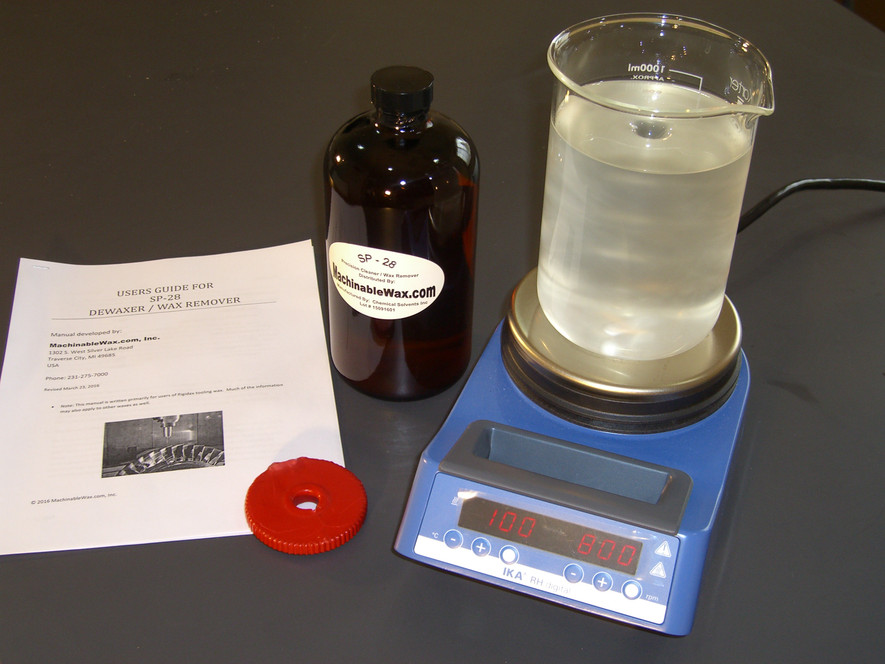
One of the most common questions we receive from customers using fixturing waxes such as Rigidax is, "What's the best way to remove the wax when the job is finished?"
The most efficient wax removal process often starts before any cleaner or solvent is introduced. Since wax is a reusable material, the first step should be recovering as much wax as possible using heat and gravity. By warming the part above the wax melting point and allowing the molten wax to drain back into a collection container, users can often recover the majority of the wax for future use while significantly reducing the amount of material that must be removed during subsequent cleaning.
Once the bulk of the wax has been recovered, the remaining residue can be removed using a variety of methods. For many applications, a simple hot oil bath is an economical and highly effective option. For applications requiring absolutely clean surfaces—such as electroplating, painting, bonding, or other critical finishing operations—a dedicated wax remover such as SP-28 may be the better choice.
Hot Oil Baths: The Workhorse of Wax Removal
After recovering as much wax as possible through gravity draining, a hot oil bath provides a simple and cost-effective way to remove the remaining wax film and residue. Because most of the wax has already been collected and recycled, the oil stays cleaner longer, operating costs are reduced, and waste generation is minimized. Mineral oil is a very common choice for this purpose due to its low cost and high availability.
For decades, manufacturers have used heated oil baths to remove fixturing and masking waxes. The process is straightforward:
- Warm the part and allow the bulk wax to drain and be collected for reuse.
- Heat the oil near or above the melting point of the wax. Be sure not to exceed recommended oil temps when working with high melt temp waxes.
- Immerse the part in the bath.
- Allow any remaining wax to melt and separate from the part.
- Agitation of the oil is not critical, but will reduce cycle times.
- Remove the part and wipe or rinse as needed.
When "Almost Clean" Isn't Good Enough
While hot mineral oil baths are extremely effective, they typically leave behind a thin oily residue. In many applications this is not a problem.
However, some manufacturing processes demand exceptionally clean surfaces. Electroplating is one of the most common examples. Even trace amounts of wax or oil can interfere with plating adhesion and finish quality. Similar concerns can arise with painting, powder coating, adhesive bonding, and certain inspection processes.
In these situations, a dedicated wax remover is often the preferred solution.
SP-28: Removing Wax and Residue
SP-28 was developed specifically for removing waxes and other manufacturing residues. Unlike a simple oil bath, SP-28 not only dissolves wax but also helps remove the oily films that can remain after conventional dewaxing methods.
SP-28 is a bio-based, semi-aqueous cleaner designed for immersion cleaning systems and soak tanks. It is particularly effective when heated near the melting point of the wax being removed and used with mild agitation.
A typical wax removal process consists of two steps:
- Remove the bulk of the wax by melting it off the part.
- Immerse the part in heated SP-28 to remove the remaining wax film and residue.
Testing has shown that heavily wax-coated metal parts can often be cleaned in just a few minutes when immersed in heated SP-28.
Additional benefits of SP-28 include:
- Excellent wax removal performance
- Low odor
- Non-hazardous shipping classification
- Compatibility with many metals and polymeric materials
- Ability to process multiple parts before replacement is required
- Effective removal of waxes, greases, lubricants, and polishing compounds
For customers involved in electroplating, aerospace work, precision manufacturing, or any process where surface cleanliness is critical, SP-28 can provide a significant advantage over hot oil alone.
Low-Cost Heating Solutions
Not every wax removal application requires expensive industrial equipment. For low-volume work, hobby shops, prototype departments, repair operations, and small manufacturing facilities, a simple heated bath can often be all that's needed.
One surprisingly effective option is the common kitchen-style "slow cooker". These units offer:
- Low initial cost
- Reliable temperature control
- Simple operation
- Compact size
- Readily available replacement parts
Many customers use Presto melters for melting wax, maintaining small hot oil baths, or heating SP-28 for bench-top cleaning operations. For low-volume applications, they provide excellent value and can eliminate the need for costly industrial tanks. The primary reason for recommending this particular style is the ability to fine-tune the temperature. Avoiding the style that only has "low/med/high" temperature settings is highly recommended.
Choosing the Right Method
The best wax removal method depends on your requirements:
Hot Mineral Oil Bath
- Lowest operating cost
- Fast removal of wax
- Excellent for general manufacturing applications
- May leave a light oily residue
SP-28 Wax Remover
- Removes residual wax and oily films
- Ideal for electroplating and critical finishing operations
- Cleaner final surface
- Suitable for precision manufacturing environments
For many users, the most efficient approach is a combination of both methods: remove the bulk wax with heat and gravity, then use oil or SP-28 as a final cleaning step.
Whether you're fixturing parts for machining, preparing components for plating, or simply looking for a cleaner workflow, choosing the right wax removal process can save time, improve quality, and reduce operating costs.