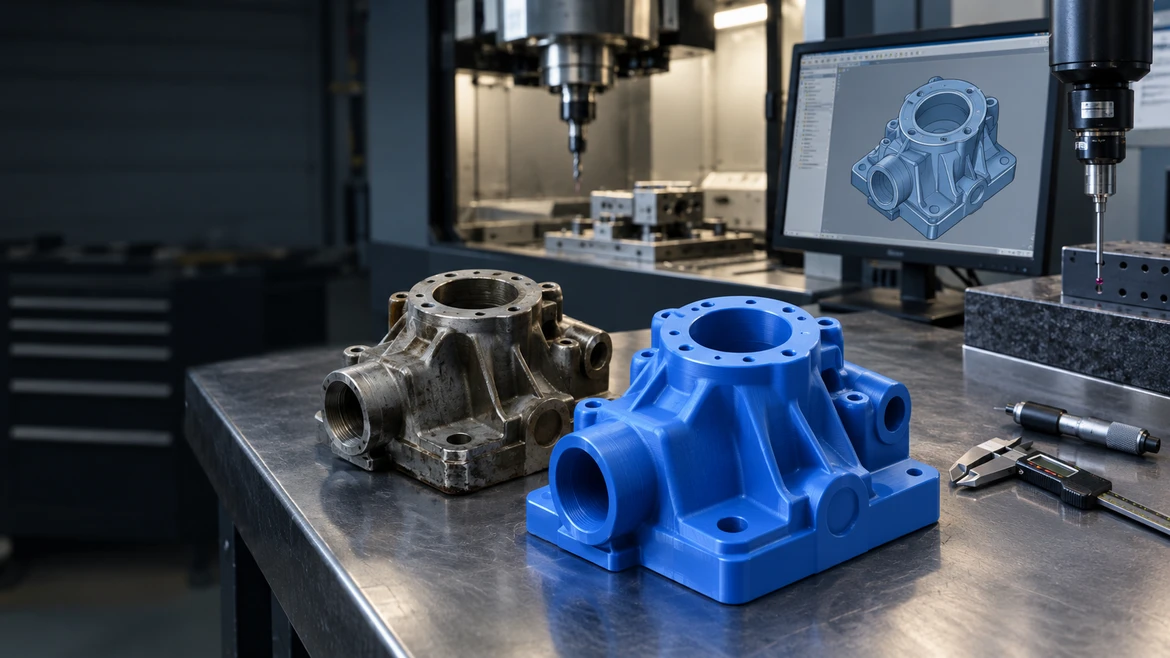
A Fast, Low-Cost Approach to Reproducing Legacy and Obsolete Components
In aerospace, defense, government, and other specialized industries, one of the biggest manufacturing challenges isn't producing a new part—it's reproducing a part that hasn't been manufactured in decades.
Legacy aircraft, military equipment, test equipment, industrial machinery, and other specialized systems can remain in service long after their original suppliers have discontinued components. Drawings may be incomplete, tooling may have been scrapped, and the original manufacturer may no longer exist.
When only one or a few replacement components are required, conventional tooling can make the job economically impractical.
Machinable wax provides another option.
By combining reverse engineering, CNC machining, and investment or lost-wax casting, machinable wax can be used to create accurate patterns for reproducing complex, low-volume, or obsolete metal components.
The Obsolescence Problem
Maintaining legacy equipment often requires manufacturing parts that were never designed with modern production methods in mind.
Engineers and machinists may encounter:
- Discontinued components
- Unavailable replacement parts
- Damaged or incomplete original parts
- Outdated drawings
- Missing or incomplete CAD files
- Castings with complex geometry
- Components requiring expensive or obsolete tooling
- Small production quantities that don't justify conventional tooling
A replacement component may be relatively simple, but producing it can still be difficult if the original manufacturing process is unknown.
This is where reverse engineering can bridge the gap between an existing physical component and a new, manufacturable part.
From Existing Part to Digital Model
The first step is typically to capture the geometry of the existing component.
Depending on the application, engineers may use:
- Manual dimensional inspection
- Coordinate measuring machines (CMM)
- 3D scanning
- Optical scanning
- Existing engineering drawings
- Photogrammetry
- A combination of these methods
The resulting information can be used to create or reconstruct a CAD model.
For some components, the CAD model can then be machined directly into metal. For others—particularly complex castings—creating a wax pattern may be a more practical approach.
Why Machine the Pattern Instead of the Final Part?
Machinable wax offers an important advantage: it is easy to cut.
Compared with machining the final metal component, machining a wax pattern can require substantially less cutting force and can be much faster, particularly when producing complex geometry.
Wax can be machined using many of the same CNC techniques used for plastics and other soft materials.
This makes it possible to take a reconstructed CAD model and rapidly produce a physical pattern without first investing in dedicated metal tooling.
For a one-off replacement or a handful of components, that can be a significant advantage.
Using Machinable Wax for Investment Casting
Once the wax pattern has been machined, it can be used in a conventional investment-casting process.
A simplified workflow looks like this:
Existing component → Reverse engineering → CAD model → Machined wax pattern → Investment mold → Metal casting → Finished component
The machinable wax becomes the sacrificial pattern.
After the investment material has hardened around the pattern, the wax is removed and the resulting cavity is filled with the desired metal alloy.
The result is a metal component reproduced from a digitally reconstructed geometry without requiring a permanent production mold or extensive hard tooling.
Complex Geometry Without Complex Tooling
One of the biggest benefits of this approach is the ability to reproduce geometry that would otherwise require complicated tooling.
Traditional casting patterns can require:
- Pattern boards
- Core boxes
- Split patterns
- Draft considerations
- Specialized tooling
- Long lead times
A CNC-machined wax pattern can eliminate much of that preliminary tooling.
This can be particularly useful when dealing with legacy components whose original tooling is no longer available.
Instead of recreating decades-old tooling, the engineer can potentially recreate the geometry itself.
That distinction can be extremely valuable when supporting obsolete equipment.
A Good Fit for Low-Volume Manufacturing
Machinable wax is particularly attractive when production quantities are small.
For example, an organization may need:
- One replacement component
- Five replacement components
- A small batch for a maintenance program
- A limited number of components for an aircraft restoration
- Prototype or test hardware
- Replacement components for legacy government equipment
Building permanent tooling for these quantities may not make economic sense.
A machined wax pattern provides a relatively inexpensive bridge between digital engineering and metal casting.
The same CAD model can also be modified and another wax pattern produced without rebuilding permanent tooling.
Reverse Engineering Gives the Process Flexibility
The real advantage isn't simply that wax is easy to machine.
It's the combination of digital reverse engineering and machinable wax.
Suppose an original component has been in service for decades. The replacement may need to incorporate changes to compensate for wear, improve strength, or accommodate currently available materials.
With a digital model, the engineer can make those changes before producing the casting pattern.
The process can therefore look like:
Measure → Model → Modify → Machine → Cast → Inspect
If the first casting requires a dimensional adjustment, the CAD model can be changed and another wax pattern can be produced.
This provides an iterative manufacturing process without requiring a new hard mold for every revision.
Prototyping Before Committing to Metal
Machinable wax can also be useful as an intermediate verification step.
Before committing to an expensive metal casting, a wax model can provide a physical representation of the proposed geometry.
Engineers and machinists can use the pattern to evaluate:
- Overall dimensions
- Fit and clearance
- Assembly interfaces
- Interference problems
- Tool accessibility
- Complex features
- Design changes
For critical applications, the wax pattern should not be considered a substitute for appropriate engineering analysis and inspection. However, it can provide a relatively inexpensive physical checkpoint during development.
Supporting Legacy Aerospace and Government Equipment
Aerospace and government equipment frequently has an unusually long service life.
Aircraft, military vehicles, naval equipment, specialized test systems, and other government assets may remain operational long after their original manufacturing programs have ended.
This creates a unique manufacturing environment.
The required component may be technically simple, but the supply chain supporting it may have disappeared.
Reverse engineering combined with modern CNC machining and casting can help move the manufacturing process away from dependence on obsolete tooling.
Instead of asking:
"Where can we find the original mold?"
the question becomes:
"Can we accurately recreate the geometry?"
When the answer is yes, machinable wax may provide an efficient path from that geometry to a cast metal replacement.
Choosing the Right Machinable Wax
Not all waxes are intended for the same purpose.
For CNC machining, the material needs to provide a useful combination of:
- Dimensional stability
- Clean cutting characteristics
- Sufficient rigidity
- Fine-detail reproduction
- Low tendency to chip or crumble
- Consistent material properties
- Compatibility with the intended casting process
For investment casting applications, another important consideration is clean burnout.
Residual pattern material can interfere with the investment mold and ultimately affect the casting.
A machinable casting wax formulated for clean removal can therefore be an important part of the process.
From Obsolete Hardware to New Production
Reverse engineering doesn't necessarily mean reproducing a part exactly as it was originally manufactured.
It can also provide an opportunity to modernize the manufacturing process.
An obsolete component can potentially be:
- Digitally captured.
- Reconstructed in CAD.
- Modified for current requirements.
- Machined as a wax pattern.
- Cast in the required alloy.
- Machined to final dimensions.
- Inspected against the engineering requirements.
This approach can transform an existing physical component into a repeatable digital manufacturing asset.
The next time a legacy component becomes unavailable, the solution may not require finding the original manufacturer or recreating decades-old tooling.
The geometry itself may be the most valuable piece of information.
And machinable wax can provide a practical connection between that geometry and a new metal component.
A Practical Tool for the Modern Reverse Engineer
For aerospace, defense, government, restoration, and other low-volume manufacturing applications, machinable wax isn't simply a modeling material.
It can be a manufacturing tool.
When combined with 3D scanning, CAD, CNC machining, investment casting, and modern inspection techniques, machinable wax can help engineers reproduce complex components while minimizing the need for expensive dedicated tooling.
For obsolete and low-volume parts, that can make the difference between a replacement being economically impractical and actually being manufacturable.
When the original tooling is gone, recreate the geometry—not necessarily the tooling.
If your team is working through a DMSMS case or reverse-engineering a legacy casting and wants to talk through material specs, machinability, or sample material, reach out — we're an established federal supplier (DUNS and SAM.gov registered) ready to support depot, arsenal, and prime-contractor sourcing needs.